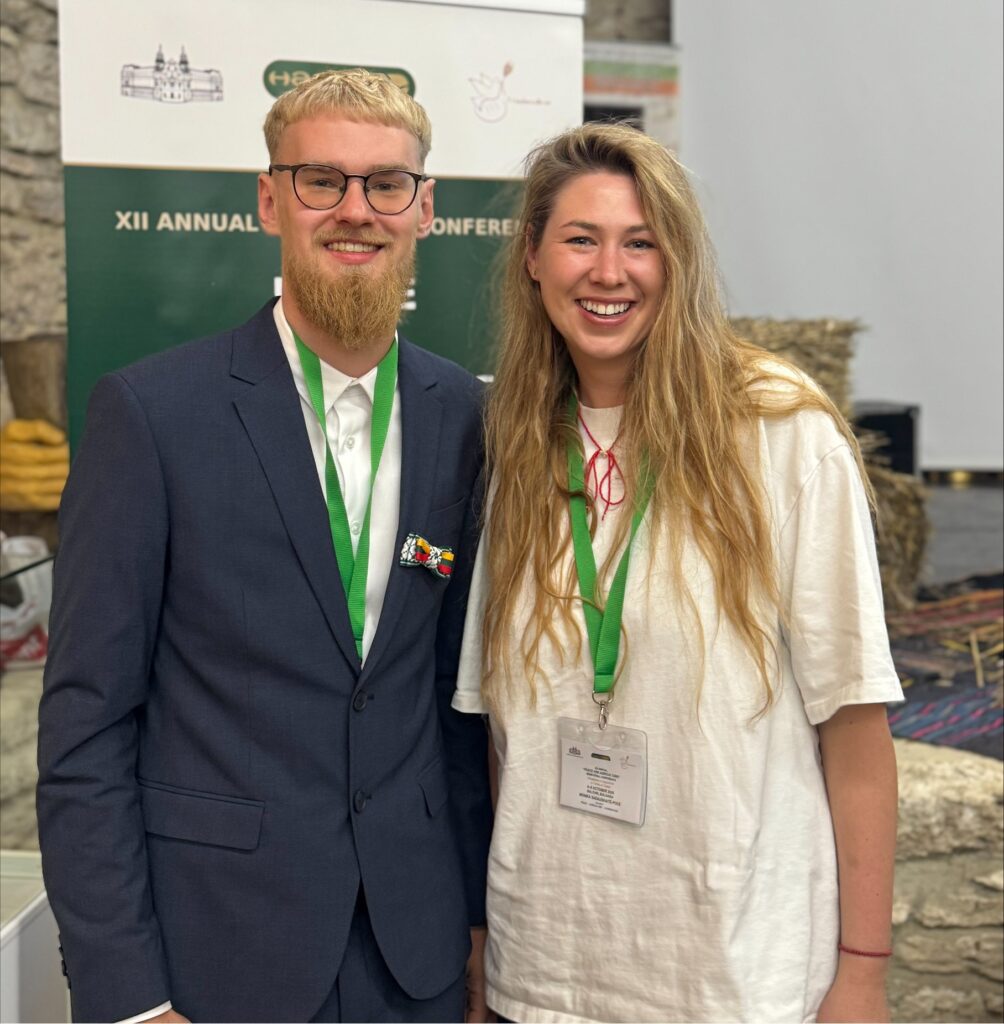
From 6 to 9 October, the 12th International Conference “Peace Bread 2026” took place in Balchik, Bulgaria, on the picturesque Black Sea coast, bringing together representatives of agricultural institutions, young farmers’ organisations and social partners from across Europe. The international initiative was also attended by representatives of member organisations of the Chamber of Agriculture of the Republic of Lithuania (CAR) – Monika Sadauskaitė-Pocė, President of the Lithuanian Countryside Tourism Association, and Jonas Ivanauskas, representing the Lithuanian Young Farmers and Youth Union.
Agricultural resilience in times of crisis – a shared European concern
The main theme of this year’s conference was the resilience of agriculture in times of crisis. The discussions focused on geopolitical challenges, climate change, economic uncertainty, food security, and the need to ensure the continuity of agricultural activities even under the most difficult circumstances.
The event brought together partners from 14 European countries. The conference provided a platform not only to discuss the challenges currently facing agriculture, but also to share practical experience, seek common solutions and strengthen cooperation.
It was emphasised that agricultural resilience depends not only on technological or economic solutions. Equally important are strong ties between farmers, effective organisations, social dialogue and the ability to cooperate at international level.
Young farmers – shaping the future of agriculture
Particular attention at the conference was devoted to the younger generation of farmers. As part of the international programme for young farmers, representatives from different European countries discussed the future of agriculture, the challenges facing farmers and the role of young people in building a more resilient and sustainable agricultural sector.
Jonas Ivanauskas, representing the Lithuanian Young Farmers and Youth Union, also took part in these discussions.
“We had very interesting and meaningful discussions with young farmers from different European countries. Although we farm under different conditions, we face many of the same challenges – climate change, economic uncertainty, rising production costs and the need to ensure the continuity and viability of our farms. Meetings like this give us an opportunity not only to share experiences, but also to recognise that we must shape the future of agriculture together. It is particularly important that the voice of young farmers is heard when decisions are made at European level,” said J. Ivanauskas.
Throughout the conference, it was repeatedly emphasised that the younger generation is not only taking forward farming traditions, but is also actively shaping the future of agriculture by seeking innovative solutions and new opportunities for cooperation.
Dialogue among social partners for stronger European regions
Monika Sadauskaitė-Pocė, President of the Lithuanian Countryside Tourism Association, participated in discussions among social partners focusing on the future of agriculture and rural areas, the importance of cooperation, and opportunities to strengthen the resilience of rural communities.
The involvement of social partners in international dialogue is particularly important in ensuring that decisions on agriculture and rural development respond not only to the needs of the agricultural production sector, but also to the broader needs of rural residents, local businesses and communities.
Rural tourism, local food production, traditional crafts and other economic activities are an integral part of vibrant rural areas. Cooperation between different sectors is therefore becoming increasingly important in strengthening regional economies, creating jobs and maintaining the attractiveness of rural areas as places to live, work and visit.
M. Sadauskaitė-Pocė’s participation in the social partners’ discussions provided an opportunity to present the experience of Lithuanian rural organisations and contribute to the international dialogue on a sustainable future for rural areas.
“Peace Bread” – a symbol of unity, cooperation and responsibility
The international “Peace Bread” initiative has been running since 2014. Its origins are linked to the symbolic cultivation of rye on the former site of the Berlin Wall. Today, the initiative brings together European countries, promoting peace, mutual understanding and cooperation through agriculture.
Every year, rye grown in different participating countries becomes part of a shared loaf of bread, symbolising the unity of European nations and the contribution of farmers to peace and food security.
Lithuania also contributed to this year’s initiative. The rye intended for the “Peace Bread” was grown by Andžej Kulevičius, Vice-President of the Chamber of Agriculture of the Republic of Lithuania and Chairman of the Šalčininkai District Farmers’ Association. The grain grown in Lithuania was transported to Bulgaria and became part of the joint international initiative.
This symbolic tradition serves as a reminder that bread is more than everyday food. It represents peace, togetherness, trust and the work of farmers on which the well-being of society depends.
International cooperation beyond the conference hall
Conference participants also had an opportunity to explore the latest agricultural machinery and innovative technological solutions, as well as to learn more about Bulgaria’s agricultural traditions and cultural heritage.
Informal meetings, discussions and exchanges of experience created opportunities to establish new partnerships and strengthen existing international ties.
The participants were united by one central message: agriculture and food production must be safeguarded under all circumstances, and achieving this requires cooperation between countries, institutions, farmers and civil society organisations.
“Peace Bread” returns to Lithuania in 2027
It was also announced during this year’s conference that the international “Peace Bread” event is planned to be held in Lithuania next year.
This will provide an important opportunity to showcase Lithuanian agriculture, the work of farmers’ organisations and the country’s regions, while further strengthening international cooperation.
The participation of representatives of CAR member organisations in “Peace Bread 2026” once again demonstrates the importance of the voice of Lithuanian farmers and rural organisations in international dialogue.
Peace, a strong agricultural sector, vibrant rural communities and cooperation between generations are the values that unite European farmers and give meaning to the “Peace Bread” initiative.