
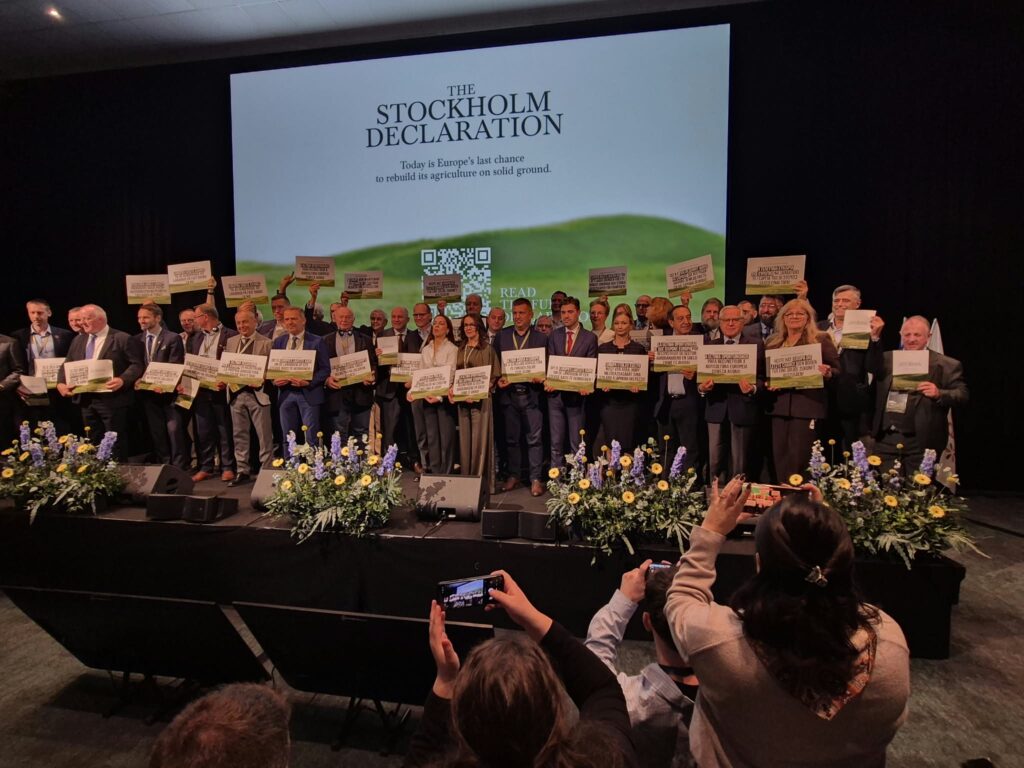
European Farmers Send a Clear Message
The 12th European Congress of Farmers is taking place in the Swedish capital from 14 to 16 October. Organised by Copa and Cogeca in cooperation with the Federation of Swedish Farmers (LRF), the event has brought together approximately 400 representatives of European farming organisations, cooperatives, institutions and other stakeholders in the agricultural sector.
This year’s Congress focuses on the competitiveness and security of European agriculture. Discussions address farmers’ incomes, rising production costs, innovation, investment, generational renewal and food security. However, one of the central issues is the EU’s next Multiannual Financial Framework (MFF) and the future of the CAP beyond 2027.
European farming organisations warn that the proposed changes to the future EU budget and agricultural policy could weaken CAP funding, undermine its common character and jeopardise the long-term stability that farmers need.
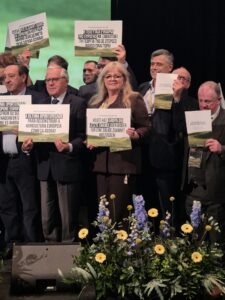
The Stockholm Declaration, signed on 15 October, represents a joint appeal by European farming and agricultural cooperative organisations to EU political leaders. The document stresses that agriculture must be recognised as a strategic pillar of Europe’s security, resilience and competitiveness.
The Declaration calls for a dedicated and ring-fenced CAP budget, with funding maintained at least at its current level and adjusted for inflation. It also highlights the need to ensure a level playing field within the European Single Market, strengthen the position of farmers and cooperatives in the food supply chain, reduce administrative burdens and create more favourable conditions for investment and generational renewal.
A. Pabedinskienė: Agriculture Must Not Be Forced to Compete for Its Survival with Other Policy Priorities
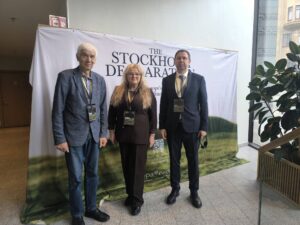
Algimanta Pabedinskienė, President of the Chamber of Agriculture of the Republic of Lithuania, notes that the concerns expressed in Stockholm also reflect the expectations of Lithuanian farmers.
“Discussions in Stockholm have once again demonstrated that European farmers are concerned not only about the level of future CAP funding, but also about the future of the policy itself. Agriculture must not become just one of many sectors competing for resources within a common fund. The CAP must remain an independent, clearly funded policy based on common principles for all farmers across the European Union,” says A. Pabedinskienė.
According to the President of the Chamber of Agriculture, the current geopolitical situation makes it even more important to recognise agriculture as a strategic sector. The effects of climate change, extreme weather events, wars, trade tensions and rising production costs are creating increasingly serious challenges for European farms.
Decisions on the future CAP must therefore not be driven solely by the objective of reallocating budgetary resources. Their impact on Europe’s ability to ensure its own food supply and maintain viable agricultural production must also be carefully assessed.
“The Stockholm Declaration is an important expression of a common position among European farmers. Its message is very clear: we cannot strengthen Europe’s security while weakening its agriculture. Food production is not merely an economic activity. It is also a foundation of our society’s security, resilience to crises and strategic autonomy,” emphasises A. Pabedinskienė.
Lithuania’s Key Priorities: Fair Direct Payments and Adequate Funding
According to the President of the Chamber of Agriculture, Lithuania must focus on several essential priorities in negotiations on the future CAP.
The first is a fairer distribution of direct payments. Lithuanian farmers operate within the same EU Single Market as farmers in other Member States, yet they still do not compete on equal terms.
“We cannot speak of fair competition when farmers operating in the same Single Market are subject to unequal support conditions. Lithuania must consistently pursue fairer direct payments and ensure that the future CAP does not widen existing disparities,” stresses A. Pabedinskienė.
Another crucial issue is the level of funding and its real value. According to the President of the Chamber of Agriculture, assessing proposals for the future EU budget requires looking beyond nominal figures. Inflation, rising agricultural production costs and investment needs must all be taken into account.
“Farmers need stability and the ability to plan their activities several years ahead. We must therefore assess not only the amounts allocated in the budget, but also the real value of the support farmers will receive. A separate crisis fund is important, but it cannot compensate for a reduction in regular CAP funding,” says A. Pabedinskienė.
Rural Development and Generational Renewal Are Equally Important
The Stockholm Declaration also emphasises the need to strengthen the competitiveness of European agriculture and invest in innovation, digitalisation, water resource management, infrastructure and the bioeconomy.
A. Pabedinskienė points out that it is particularly important for Lithuania to maintain adequate funding for rural development measures, farm modernisation, agricultural cooperation and support for young farmers entering the sector.
“Strong agriculture is impossible without vibrant rural communities. We must create conditions that enable farmers to invest, modernise their farms, introduce new technologies and pass their businesses on to the younger generation. If rural development funding becomes dependent on competition with other national priorities, there is a risk that the long-term needs of agriculture will be pushed aside,” she says.
According to the President of the Chamber of Agriculture, the future CAP must also be simpler and easier for farmers to understand. Reducing administrative burdens must translate into practical measures, while greater flexibility for Member States must not result in even wider disparities in competitive conditions.
Lithuania’s Voice Must Be Heard at European Level
The President of the Chamber of Agriculture notes that the active participation of Lithuanian farmers’ self-governing organisations in European-level organisations is particularly important as 2027 approaches, when Lithuania will hold the Presidency of the Council of the European Union.
During this period, decisions will be taken on agricultural policy, funding and competitiveness that will have significant implications for both Lithuania and Europe as a whole. It is therefore essential to build alliances, coordinate positions and ensure that representatives of farmers’ organisations are involved in the decision-making process.
“Lithuania’s position in the negotiations must be clear: a strong CAP, fair competitive conditions and genuine financial security rather than mere assurances. Food production is a strategic issue for European security, and agricultural funding must therefore be regarded as an investment in Europe’s shared future,” emphasises A. Pabedinskienė.
The Declaration signed in Stockholm sends a clear message to the institutions of the European Union: decisions on the future CAP and EU budget will have long-term consequences not only for farmers, but for all European citizens.
European farming organisations are united in their message: defending the Common Agricultural Policy today means safeguarding Europe’s food security, competitiveness and resilience for the future.