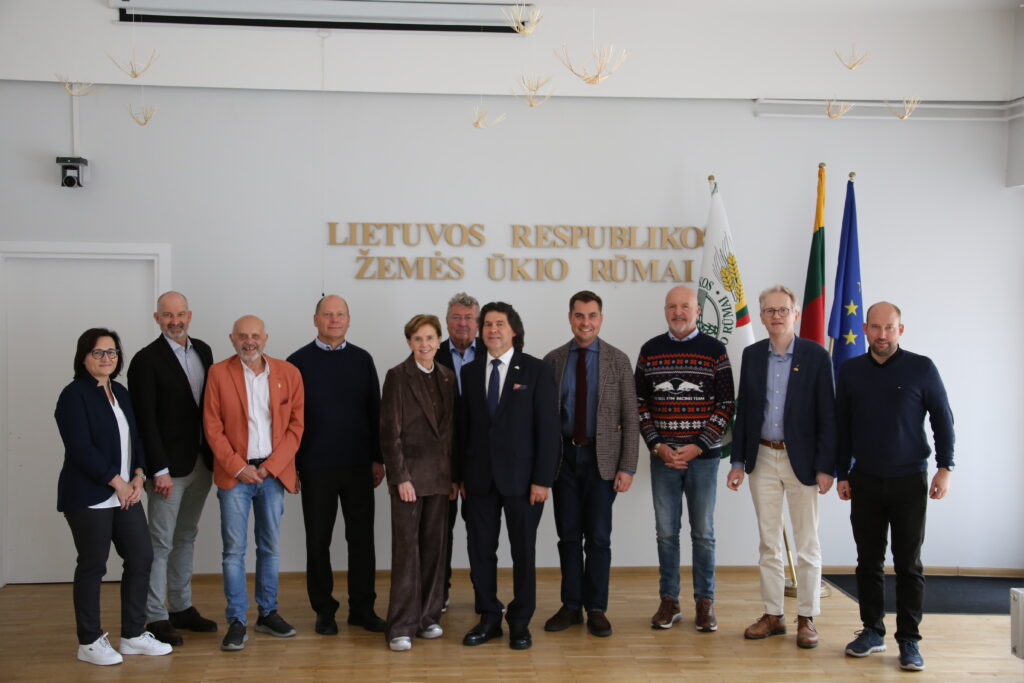
The Austrian delegation visited Lithuania from 18 to 21 October. The delegation visiting the Lithuanian Chamber of Agriculture included Dr Brigitta Pallauf, President of the Salzburg State Parliament; Dr Johannes Aigner, Ambassador of the Republic of Austria to Lithuania; Andreas Teufl, Second President of the Salzburg State Parliament; parliamentary group leaders Dr Andreas Schöppl and Dr Markus Maurer; members of the State Parliament Hannes Schernthaner, Alexander Rieder and Simon Heilig-Hofbauer; Dr Wolfgang Kirchtag, Director of the State Parliament Administration; and Eva Grünberger, Deputy Director of the Administration.
The guests were welcomed by Sigitas Dimaitis, Director of the Lithuanian Chamber of Agriculture, who conveyed warm greetings from Algimanta Pabedinskienė, Chairwoman of the Chamber. He thanked the delegation for their visit and emphasised the importance of cooperation between Lithuanian and Austrian farmers, the exchange of experience, and the search for common solutions.
The meeting took place in a particularly significant year, as the Lithuanian Chamber of Agriculture celebrates its 100th anniversary in 2026. The guests were introduced to the Chamber’s activities, the structure of Lithuanian agriculture, the sector’s main areas of activity, and the challenges faced by farmers.
Farm Succession – A Shared European Challenge
One of the key topics discussed during the meeting was the transfer of farms to the younger generation. Participants explored ways to ensure the continuity of family farms, preserve knowledge and experience accumulated over generations, and create conditions that encourage young people to choose farming as a promising career.
The Austrian representatives shared their experience of preserving farming traditions in the federal state of Salzburg, where the history of some family farms dates back as far as the 17th century. The importance of agricultural vocational schools, practical training and apprenticeship opportunities was highlighted, along with the need to ensure that young people can study, work and build their futures in rural areas.
The discussion also addressed the role of youth organisations in strengthening rural communities, encouraging the active involvement of young farmers, and passing knowledge from one generation to the next.
The Role of Women and the Links Between Agriculture and Tourism
The meeting also focused on the growing role of women in agriculture. Austria’s experience demonstrates that an increasing number of women are managing farms, joining professional organisations, contributing to public education and strengthening local communities.
Opportunities for cooperation between agriculture and tourism were also discussed. In the federal state of Salzburg, farming is closely linked to rural tourism, the production of traditional food products and direct sales to consumers.
The Austrian representatives presented regional traditions, events organised by local farmers, and celebrations that help preserve cultural heritage. One of the best-known traditions is the ceremonial return of cows from Alpine pastures, during which the animals are decorated with flowers, bells and traditional ornaments. These celebrations attract large numbers of visitors every year.
Such initiatives not only help preserve regional traditions but also provide farmers with additional income and strengthen the local economy.
Shared Challenges Require Joint Solutions
Representatives of Lithuania and Austria discussed the impact of climate change on farming, the introduction of new production methods, the development of seed production and the need to adapt to changing environmental conditions.
The discussion also highlighted issues relevant to farmers in both countries, including administrative burdens, documentation requirements, taxation and European Union regulations.
It was emphasised that excessive administrative obligations increase farmers’ workloads. Therefore, solutions are needed to reconcile environmental and other societal expectations with the economic viability of farms.
The participants agreed that international cooperation and the exchange of practical experience are essential for identifying effective solutions that help preserve family farms, encourage young people to pursue careers in agriculture, and strengthen the vitality of Europe’s rural regions.
During the visit, the guests were also invited to taste traditional Lithuanian food products recognised as part of the country’s national heritage, whose production methods have been passed down from generation to generation. The Chamber also presented its initiative, the “Made by Lithuanians” online store, which helps products made by Lithuanian producers reach consumers.
The guests also met Inga Kilčiauskienė, a member of the Lithuanian Countryside Tourism Association, with whom they discussed opportunities for developing rural tourism, preserving local traditions, and strengthening cooperation between agriculture and tourism.
The delegation’s programme continued at “Margio krantas”, a rural tourism homestead in the Trakai district, where a joint lunch was held. This provided an excellent opportunity to continue discussions in an informal setting about the importance of rural tourism, the promotion of local products, and prospects for cooperation between Lithuanian and Austrian regions.
The Lithuanian Chamber of Agriculture expresses its gratitude to the delegation from the Salzburg State Parliament for the meaningful meeting and hopes that the connections established will contribute to further cooperation between the agricultural and rural tourism communities of Lithuania and Austria.