
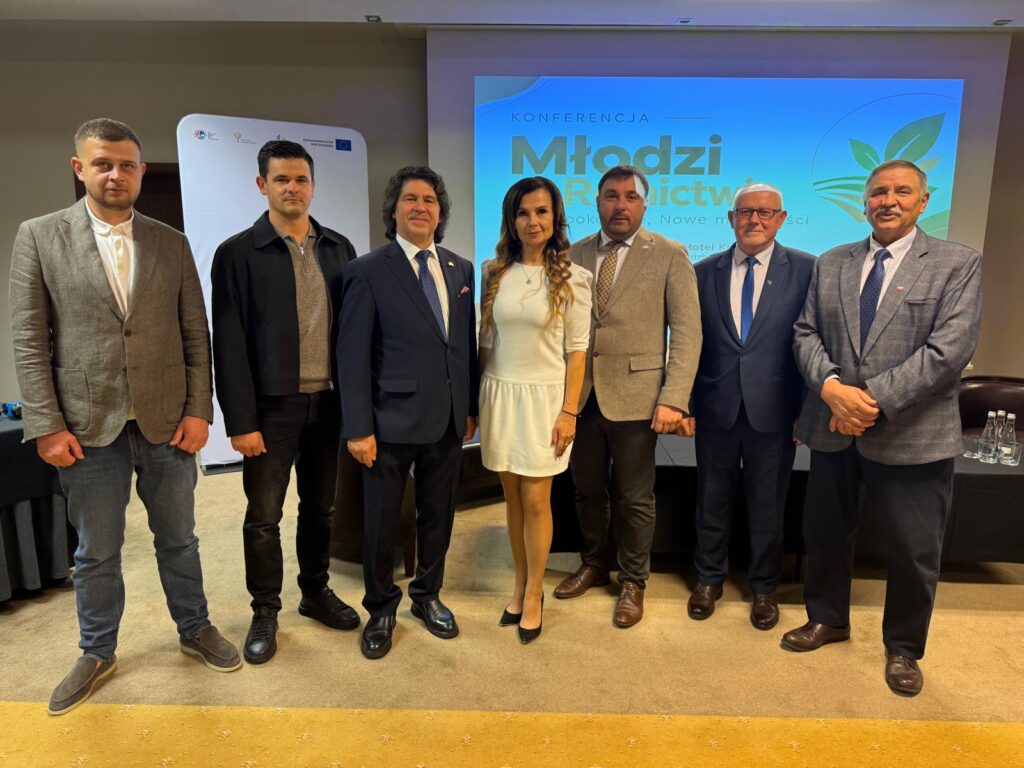
Organised by the Warmia and Masuria Chamber of Agriculture, the conference focused on the future of young farmers, generational renewal on family farms, emerging technologies, investment opportunities, the Common Agricultural Policy (CAP), and the development of additional business activities in rural areas.
Young Farmers Need to See a Viable Future
The conference was opened by Sylwia Jaskulska, Deputy Marshal of the Warmian-Masurian Voivodeship, and Romuald Tański, President of the Warmia and Masuria Chamber of Agriculture.
One of the main themes was the rapid transformation of farming and the role of technology in the farms of the future. Dr Leszek Sieczko presented five technological trends that could significantly transform agriculture over the next decade. Practical experiences were also shared through examples from five different farms, illustrating various approaches to farming and business development.
ŽŪR Vice-Chairman Andžej Kulevičius pointed out that young farmers in Lithuania and Poland face many similar challenges.
“It is not enough to tell a young person to take over their parents’ farm and continue the family tradition. They need to see a viable economic future, have opportunities to invest, use modern technologies, and be confident that farming will provide them with a decent living.
“If we want to preserve family farms, we must create conditions that encourage young people not only to enter agriculture but also to remain in the sector. This is relevant to Lithuania, Poland and the entire European Union,” said Kulevičius.
Generational Renewal – One of the Greatest Challenges Facing European Agriculture
Considerable attention was devoted to farm succession and generational renewal.
During the discussion “Is Taking Over a Farm Worthwhile Today? Opportunities, Risks and the Future for Young Farmers”, participants examined the economic and social factors influencing young people’s decisions to continue their families’ farming traditions.
Presentations on the second day explored how to organise the transfer of farms to the next generation, avoid family conflicts and prepare effectively for the succession process.
Young farmer Andžej Rudzis, who participated in the conference, emphasised that the younger generation of farmers is not seeking privileges but long-term certainty.
“When a young farmer takes over or establishes a farm, they are not making decisions for just one year. We invest in land, machinery, buildings and technology, and we take on financial commitments. That is why it is so important for us to know what conditions we will be working under in five or ten years.
“Initial financial support is important, but even more important is a stable and predictable agricultural policy that enables farms to generate income and develop independently,” said Rudzis.
New Technologies Are No Longer Optional – They Are Part of Everyday Farming
The conference also placed considerable emphasis on technological change, investment planning and new communication tools.
Discussions covered financial mistakes when investing in farms, the use of social media to increase awareness of farmers and their products, innovative farming methods, and opportunities to diversify farm activities.
Young farmer Evald Aželionis noted that technology is becoming an essential element of farm competitiveness.
“Young farmers are interested in technology not because it is fashionable. Technology must help us work more precisely, save time and resources, reduce costs and make better decisions.
“However, technology alone does not solve problems. Farmers need knowledge, investment and the ability to adapt innovations to the specific conditions of their farms.
“That is why meetings like this are so valuable. They allow us to see what farmers in other countries are already doing and assess which solutions could be meaningfully applied on our own farms in Lithuania,” said Aželionis.
The CAP Must Help Build Economically Viable Farms
The Common Agricultural Policy was another important topic of the conference.
Grzegorz Graszk, a representative of Poland’s Agency for Restructuring and Modernisation of Agriculture, presented the opportunities available to young farmers under the CAP.
Participants also discussed support opportunities under the 2023–2027 CAP Strategic Plan for non-agricultural economic activities through Local Action Groups.
Such measures can help diversify family farm incomes and create additional employment opportunities in rural areas.
ŽŪR Director Sigitas Dimaitis stressed that the challenge of generational renewal cannot be addressed through one-off measures alone.
“Generational renewal in agriculture is not simply a question of how many young farmers receive start-up support. We need to ask how many of them will still be farming successfully in ten years.
“Young farmers need access to land, capital, knowledge and technology, and, most importantly, market conditions that allow them to earn a living from the products they produce.
“CAP measures must help establish economically viable farms rather than make farmers permanently dependent on subsidies,” said Dimaitis.
Direct Dialogue Between Lithuanian and Polish Young Farmers Is Essential
The conference provided not only an opportunity to exchange knowledge but also a meeting point for Lithuanian and Polish agricultural self-governance organisations and young farmers.
The Chamber of Agriculture of the Republic of Lithuania and the Warmia and Masuria Chamber of Agriculture share a common objective: to ensure that farmers’ voices are heard in agricultural policymaking and that the younger generation has genuine opportunities to take over, modernise and develop family farms.
“It is extremely valuable to talk not only in conference halls but also directly with Polish farmers.
“You quickly realise that many of the challenges are the same on both sides of the border: production costs, investment, bureaucracy, generational renewal and uncertainty about the future.
“At the same time, we can share solutions and ideas. Young farmers certainly need more of these direct international connections,” said Rudzis.
According to Aželionis, seeing practical examples from other farms is particularly beneficial.
“You can learn a great deal from theory, but what interests farmers most is how a particular solution works in practice.
“What has another farmer tried? How much did they invest? What worked, and where did they make mistakes?
“This kind of exchange of experience can sometimes be more valuable than any textbook,” said Aželionis.
ŽŪR Director Sigitas Dimaitis believes that direct cooperation between Lithuanian and Polish chambers of agriculture and young farmers should continue to develop in the future.
“Poland is our neighbour and one of the most important agricultural countries in the region.
“We have many shared interests, so it is essential that cooperation takes place not only between institutions but also between farmers themselves.
“Meetings like this allow young farmers to establish contacts, exchange experiences and better understand that many questions concerning the future of agriculture will have to be addressed within a common European framework,” concluded Dimaitis.