

On December 4–6, the international viticulture and enology conference VitiNord was held in Vilnius for the first time, bringing together more than 140 grape growers from around the world.
The VitiNord conference, held every three years in a different country, brings together grape growers, winemakers, scientists, and business representatives from all regions where wine is produced in cold or cool climate conditions. This year, the Lithuanian Grapegrowers Association was entrusted with organizing the event. Clearly, the organization handled the challenges exceptionally well!
The conference guests and participants were welcomed by Speaker of the Seimas Juozas Olekas, who wished international visitors an enriching experience in Lithuania and local grape growers new knowledge and insights.
Around two dozen winemakers from the United States and Canada flew in especially for the conference, and a particularly large delegation arrived from the Scandinavian countries—Norway, Finland, and Sweden. Many grape growers also came from Estonia. The Lithuanian delegation was also sizeable, with 17 participants attending the conference.
All participants were highly impressed with the content of the conference. The organizers selected a wide range of competent speakers who delivered presentations on a variety of topics relevant to winemakers.
“During the event, we examined the impact of climate change on grapes, the arguments behind choosing specific varieties, the nuances of marketing, opportunities to strengthen wine consumption culture, and other important topics. These issues may not be particularly relevant for traditional southern wine-producing countries, but for us Lithuanians and other northern-climate grape growers, they are extremely important,” emphasized the head of the Lithuanian Grapegrowers Association, Ramūnas Pilvelis.
Over the course of two intensive days, participants heard 24 different presentations. One day of the event was dedicated to strengthening practical skills. Winemakers from around the world visited the family-run vineyard Geltoni botai in the Vilnius district, where about 1.2 hectares of grapes are grown, along with several plots of other berries. Visitors received advice on how to protect grapes from winter and spring frosts, saw demonstrations of pruning techniques, learned which methods to choose, and how these affect the plants.
“Both Lithuanians and foreign participants gained invaluable experience that would be difficult to acquire elsewhere. I can confidently say that this conference is equivalent to a full university course for training grape growers. Overall, the benefits for participants extended beyond lectures and practical training. Since the attendees were professional winemakers with extensive experience, informal conversations, information sharing, and new connections will undoubtedly be useful in the future,” said R. Pilvelis.
He was confident that the experience gained at the event would help Lithuanian grape growers expand their vineyards even further. According to the head of the association, vineyard areas in Lithuania have been steadily increasing over recent decades, with new winemakers emerging each year. Harsh winters are not a concern for them, as many varieties capable of withstanding temperatures as low as –30°C have already been developed. Spring frosts, which can damage budding vines, may pose a greater risk, but there are reliable methods for dealing with that as well.
“Grapes grown in northern climates have several advantages over those grown in traditional southern countries. In recent years, southern regions have been experiencing severe heat waves, and the grapes grown there suffer from heavy chemical use. Grapes grown under northern conditions are far more environmentally friendly and more resistant to disease. Moreover, they allow the production of wines with lower alcohol content, which has become increasingly popular in recent years. For all these reasons, southern growers are now also beginning to cultivate varieties better suited to northern conditions,” noted R. Pilvelis.
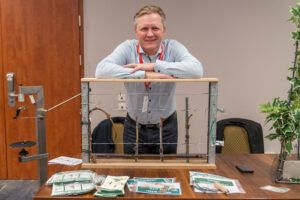
He had no doubt that grape growing has strong prospects and should become an even more popular agricultural sector in the near future. Although this year was not the most successful for grape growers—compared with the record-breaking 2024 season, the summer brought far less sunshine, resulting in grapes that ripened with lower sugar content—this has not diminished his or other winemakers’ motivation.
“Weather around the planet is becoming increasingly unpredictable, but we must learn to adapt. During the international VitiNord conference in Vilnius, we learned many ways to do just that,” said the head of the Lithuanian Grapegrowers Association.

“The international VitiNord conference demonstrated that Lithuanian viticulture is making strong and confident progress. Our country’s growers are already working within the same knowledge space as experienced winemakers from the United States, Canada, Scandinavia, and other northern-climate regions. The insights gained on climate-change challenges, variety selection, cultivation techniques, and marketing solutions not only enhance professionalism but also open new opportunities for the entire sector. We clearly see that the northern viticulture model is becoming increasingly competitive, and Lithuania has every prerequisite to stand among its leaders,” emphasized the Director of the Chamber of Agriculture, Sigitas Dimaitis.