Representatives of the Chamber of Agriculture of Lithuania (ŽŪR) took part in an international “Peace Bread” initiative event held in Hungary. The event’s main goal was to highlight the role of sustainable agriculture in maintaining peace worldwide.
Through Bread – About Agriculture
This annual event, held in a different country each year, brings together representatives of governmental institutions and various NGOs from twelve former “Iron Curtain” countries — Lithuania, Estonia, Latvia, Bulgaria, Germany, Poland, Romania, Slovakia, Slovenia, the Czech Republic, Hungary, and Croatia.
According to ŽŪR Vice-Chairman Algis Baravykas, who has participated in this initiative for the fifth time, the event also carries a spiritual dimension. The first meeting of this kind took place in 2014 in Germany, on the site of the former Berlin Wall.
“Rye was grown there and later used to bake bread. That bread became a symbol of peace, serving as a bridge for cooperation. While discussions revolve around agriculture, the importance of global peace is also strongly emphasized,” said A. Baravykas.
In recent years, the war in Ukraine has become an inevitable topic of discussion. The conflict has shaken the foundations of global food security. By targeting Ukraine—one of the world’s key food suppliers—Russia seeks to weaponize food, disrupting grain exports, increasing prices, and pushing millions of vulnerable people, especially in Africa and the Middle East, toward hunger.
The “Peace Bread” event usually attracts not only farmers and representatives of agricultural organizations but also high-level politicians, including ministers, vice-ministers, and chancellors. This year, Lithuanian Vice-Minister of Agriculture Gediminas Tamašauskis joined the delegation to Hungary.
The 2025 meeting was held in Szarvas, Hungary, home to the local branch of the “Peace Bread” organization led by a Lutheran pastor. The town also hosts several agricultural research and education institutions.
Emerging Trends
“As in previous years, participants discussed key agricultural challenges. The aging of rural areas was once again a major topic. Fewer young people want to live in villages, so this year’s event invited many young participants from different countries to share their concerns and ideas for solutions.
Most discussions focused on the future of the Common Agricultural Policy (CAP) financing. There is growing concern that the expected reduction in agricultural funding and the creation of new funds during the 2028–2035 financial period could cause serious harm,” said Baravykas.
Although rural aging was widely discussed, Baravykas noted the lack of concrete solutions. He recalled that the topic was explored in greater depth a few years ago during the “Peace Bread” meeting in Slovenia, where participants also examined future models of farming.
“Fewer people are willing to tie their lives to rural areas, so maybe agricultural companies or cooperatives could be viable alternatives. Employees there receive competitive wages, have weekends off, vacations, and social guarantees—unlike individual farmers, who carry all risks on their own. Across Europe, discussions continue about which farming model is more sustainable in the face of climate change, disease, and market instability. Farms are consolidating, workloads are increasing, and young people find it harder to start farming,” he added.
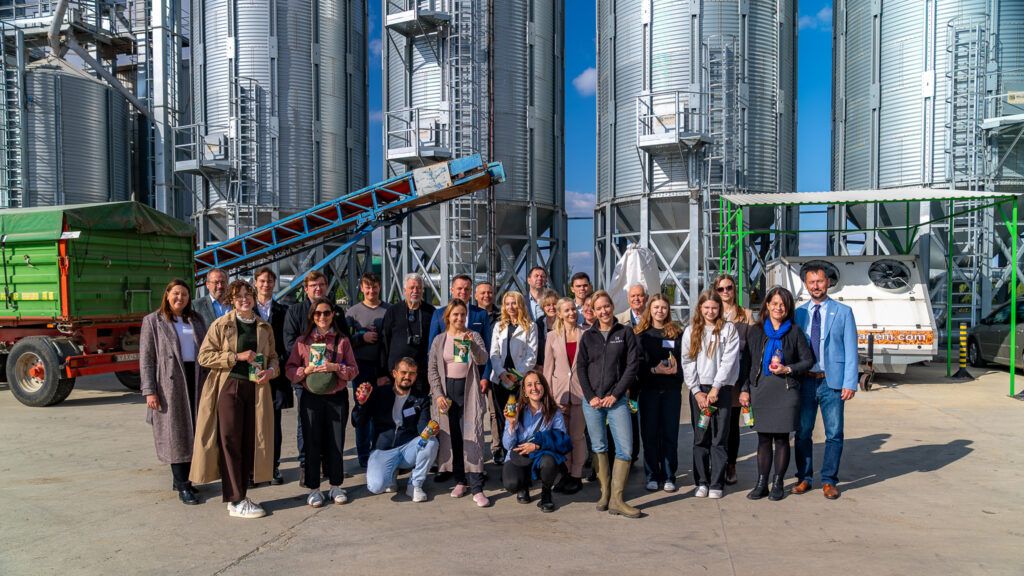
Participants also visited a local rice elevator capable of storing about 25,000 tons at a time. Many were surprised to learn that rice has been grown in that part of Hungary for over a century. The delegation observed rice cultivation, sorting, cleaning, and packaging processes, and tasted innovative rice-based products, such as health drinks.
Inequality Persists
Young Lithuanian farmer Aurimas Gelbūda said the event provided valuable insights and confirmed that farmers across the EU face similar problems, despite differences in local conditions. Economic, ecological, and social challenges were central to discussions.
“People demand high-quality food, yet the EU plans to cut agricultural funding. This will inevitably affect production quality. If we aim to reduce the use of chemicals but also reduce funding, it’s unrealistic to expect progress—technology and innovation require investment. Education in agriculture, both in schools and universities, also deserves more attention,” said Gelbūda.
A dairy farmer himself, Gelbūda noted sharp differences in milk prices:
“In Germany, farmers receive over 45 cents per liter, while in Lithuania we get only around 30. We share the same market, but the purchase prices differ dramatically. Lithuanian farmers may have strong moral support, but financially we struggle. There’s too much inequality.”
Despite this, Gelbūda remains optimistic and plans to continue expanding his family’s dairy farm, preserving the traditions started by his parents.
A Valuable Experience
The event was also attended by Vytautas Abukauskas, a representative of the Lithuanian Young Farmers and Youth Association (LJŪJS). He described the trip as highly valuable, informative, and full of lessons—especially about constructive communication with policymakers.
“Too often, we try to achieve something by shouting and not listening. We learned that effective advocacy requires respect and preparation: we must identify problems, propose solutions, and then approach policymakers with concrete ideas,” Abukauskas explained.
He also observed that farmers across Europe face similar structural issues: rising costs, land concentration by large corporations, and stark land price disparities driven by productivity scores and national wealth.
“The experience was enriching. I learned how farmers in other countries live and work. For example, in Lithuania, a medium-sized farm is 100–300 ha, while in Bulgaria even 600 ha is not considered large,” he said.
ŽŪR Vice-Chairman Baravykas concluded that such events not only broaden participants’ horizons but also build invaluable international relationships.
“These gatherings bring together the agricultural community, fostering long-term ties that can later benefit our countries. It’s crucial not only to share experiences but also to observe how events are organized, since one day it will again be Lithuania’s turn to host the ‘Peace Bread’ meeting—just as we did in 2019.
For instance, last year’s event in Germany largely avoided the topic of the war in Ukraine. I suggested drafting a resolution to urge national agriculture ministers to increase support for Ukraine. Coincidentally, the Ukrainian Minister of Agriculture was present at the time and expressed gratitude for our solidarity,” Baravykas recalled.