
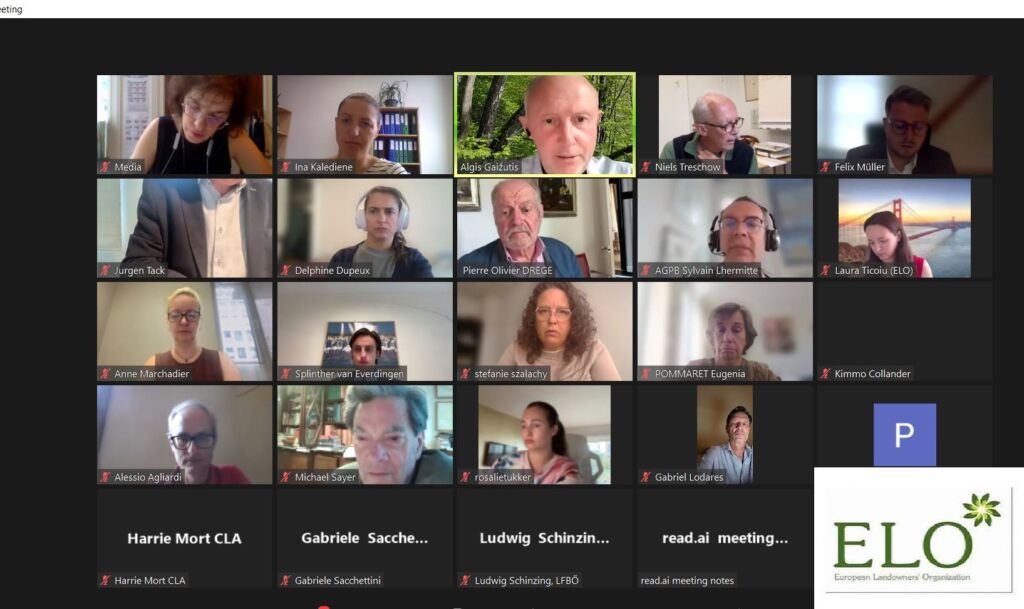
On 4 September, a meeting of the European Landowners’ Organization (ELO) Policy Group (EPG) took place, bringing together representatives from across Europe, including representatives of the Lithuanian Forest and Land Owners Association and the Lithuanian Family Farmers’ Union.
The meeting addressed some of the most pressing EU policy issues currently affecting European farmers and landowners – from the future of the Common Agricultural Policy (CAP) and its financing to nature restoration, carbon farming and forestry.
The ELO Policy Group devoted considerable attention to political decisions that will shape European agriculture in the coming years. Among the key issues were the future CAP and the need to ensure adequate funding for it, as well as the European Union’s future Multiannual Financial Framework (MFF).
These decisions are particularly important for farmers, as they will determine not only the level of support available to agriculture, but also farmers’ ability to invest in farm modernisation, strengthen resilience and competitiveness, and ensure the long-term economic viability of their farms.
Reducing the administrative burden on farmers
The meeting also addressed the simplification of EU legislation. Discussions highlighted the need to reduce the administrative burden on farmers and landowners and to ensure that the implementation of EU legislation becomes clearer and simpler.
The agricultural sector is subject to an increasing number of environmental, climate, animal welfare and other requirements. It is therefore essential that new rules are practical to implement and do not create a disproportionate bureaucratic burden.
Participants stressed that while pursuing the European Union’s ambitious objectives, it is equally important to safeguard the economic viability and competitiveness of farms.
From livestock farming to the land market
The ELO Policy Group agenda also included the EU livestock strategy and land market monitoring.
Access to land and changes in the land market are important issues for many European countries, particularly in the context of the continuity of family farms, generational renewal and the ability of young farmers to enter and develop their farming activities.
The future of the livestock sector was another important topic of discussion. When shaping long-term EU policy, it is essential to consider not only environmental and climate objectives, but also the economic and social importance of livestock farming for Europe’s rural areas.
Nature restoration, carbon farming and nature credits
Part of the meeting was dedicated to nature restoration policy, carbon farming and nature credits.
These areas are becoming increasingly important components of European agricultural and land-use policy. At the same time, questions remain about how environmental objectives will be implemented in practice and what role farmers and landowners themselves will play in this process.
The discussions emphasised that farmers and landowners should not merely be expected to comply with new requirements – they must also be active partners in shaping and implementing EU policies.
It is important that farmers are properly rewarded for the environmental benefits and ecosystem services they provide and that new measures create genuine economic opportunities.
Forestry also in focus
The meeting also addressed the implementation of the EU Deforestation Regulation (EUDR) and other forestry policy issues.
For forest owners, as for farmers, achieving the right balance between environmental objectives, property rights, opportunities for economic activity and administrative requirements is becoming increasingly important.
ELO discussions therefore highlighted the need to assess the practical impact of policy decisions on the people who own, manage and maintain land and forests and carry out economic activities on them.
Lithuania’s voice at European level
Participation in ELO activities provides an opportunity to present and discuss the positions of Lithuanian farmers in the broader European context, exchange experience with organisations from other countries and engage directly in discussions on the future of EU agricultural and land-use policy.
The Lithuanian Forest and Land Owners Association and the Lithuanian Family Farmers’ Union actively participate in the activities of the European Landowners’ Organization, seeking to ensure that Lithuania’s voice is heard in European policymaking and that the interests of Lithuanian farmers and landowners are properly represented.