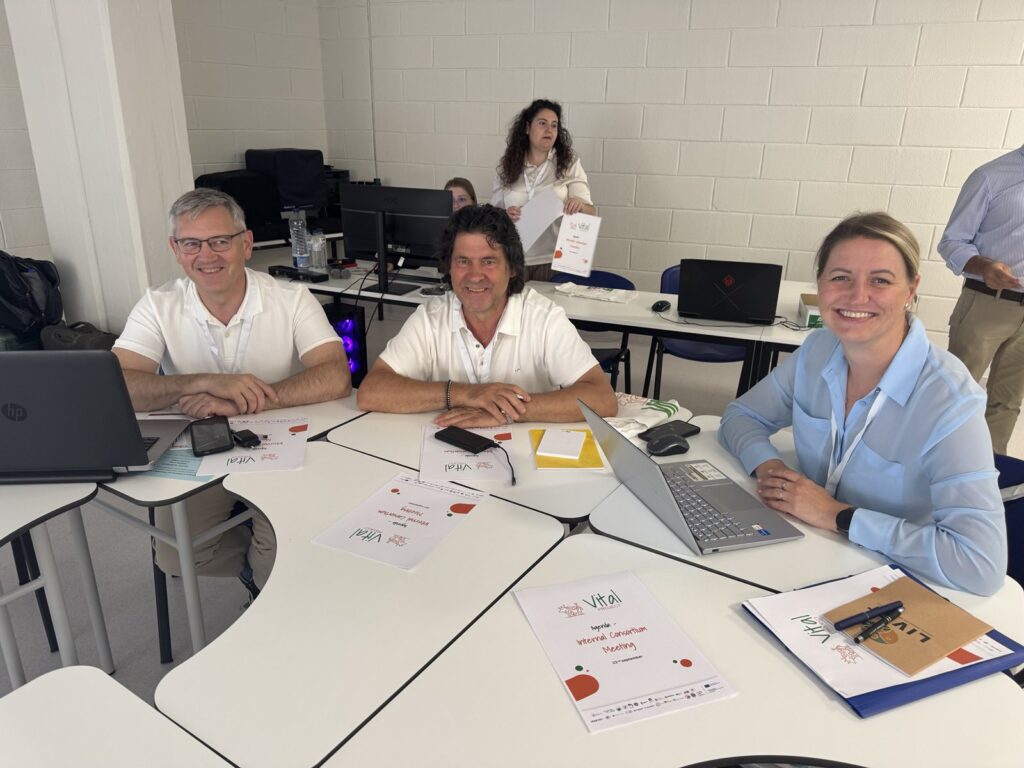
Representatives of the Chamber of Agriculture of the Republic of Lithuania (ŽŪR) visited Portugal, where they took part in activities of the international Erasmus+ project VITAL – Vocational Innovation and Training for Animal Livestock (Project No. 101246679).
Lithuanian farmers and the livestock sector were represented by Sigitas Dimaitis, Director of the Lithuanian Chamber of Agriculture; Ina Kalėdienė, Head of the Project Management Division at the Chamber; and Dr Edvardas Gedgaudas, Director of the Lithuanian Cattle Breeders’ Association (LGVA).
On 23–24 September, the VITAL project partner, the University of Trás-os-Montes and Alto Douro (UTAD), hosted an international workshop in Vila Real, Portugal, focusing on skills gaps in the livestock sector and the competences that will be needed in the future.
From smart technologies to animal welfare
During the international meeting, project partners, researchers, livestock sector representatives and practitioners discussed the knowledge and competences that the European livestock sector will require in the near future.
Particular attention was paid to digital transformation and precision livestock farming. Solutions involving smart sensors for monitoring cattle health and reproduction, livestock monitoring and geofencing technologies, as well as opportunities for applying artificial intelligence in livestock farming, were presented.
Other important topics included the green transition, more sustainable livestock production, manure management and the reduction of greenhouse gas emissions, biosecurity, animal health and welfare, and the use of new technologies in modern meat production.
“The strength of the VITAL project lies in bringing science, educational institutions, farmers’ organisations and businesses together around the same table. This allows us to identify very clearly which specialists and competences the sector is currently lacking. If we want European and Lithuanian agriculture to remain competitive, vocational education and training must evolve alongside the technologies used on farms and the real needs of farmers,” says Sigitas Dimaitis, Director of the Lithuanian Chamber of Agriculture.
Knowledge must reach the farm
The VITAL project brings together universities, vocational education and training institutions, research organisations, businesses and livestock sector organisations from different European countries. Lithuania is represented in the project by the Chamber of Agriculture of the Republic of Lithuania and Vilnius University of Applied Sciences.
One of the project’s key objectives is to reduce the gap between the competences acquired through vocational education and training and the actual needs of the labour market and livestock farms.
Ina Kalėdienė, Head of the Project Management Division at the Lithuanian Chamber of Agriculture, emphasises that the introduction of technology alone does not guarantee progress – people must also know how to use it and understand the value it can create.
“We can offer a farm the most advanced technology available, but it will only create value if people know how to use it properly. This is why the VITAL project is not only about innovation, but first and foremost about competences – what knowledge farmers, veterinarians, livestock specialists and advisers will need. It is particularly important to us that the training programmes being developed are practical, flexible and responsive to the real needs of the sector,” says Ina Kalėdienė.
Discovering Portugal’s distinctive Maronesa cattle breed
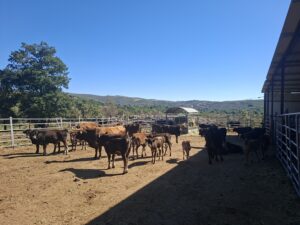
The Portuguese native Maronesa cattle breed attracted particular interest from the Lithuanian delegation.
Maronesa is an indigenous Portuguese cattle breed closely associated with the Marão, Alvão and Padrela mountain regions in northern Portugal. It is regarded as a local breed that is highly resilient and exceptionally well adapted to mountainous conditions.
The appearance of Maronesa cattle is also distinctive. The animals are medium-sized, with coats ranging from dark brown to almost black. They have short, expressive heads, while their horns initially extend horizontally before turning forwards and downwards, with the tips curving upwards and outwards. Their strong, hard hooves and agile movement make them particularly well adapted to rocky and steep mountain terrain.
Maronesa is not a large breed developed for intensive beef production. Its value lies elsewhere – in its resilience, adaptation to local conditions, ability to utilise natural pastures, reproductive characteristics and distinctive products.
The breed reaches sexual maturity relatively early, with the first fertile oestrus occurring at an average age of around 15 months. Portuguese breed data indicate a fertility rate of approximately 86.6%.
The Maronesa production system is closely linked to the mountainous landscape and traditional local farming practices. Adult cattle spend much of their time grazing on natural pastures and are housed when weather conditions are unfavourable. During the first months of life, calves are primarily fed on their mothers’ milk, with locally produced feed gradually added to their diet.
Historically, Maronesa cattle were also valued as working animals. Their strong legs, hard hooves and agility enabled them to work in difficult mountainous terrain. Today, however, the breed is primarily raised for beef production.
Carne Maronesa DOP – meat whose value is also rooted in its origin
The distinctive nature of the Maronesa breed in Portugal is linked not only to the preservation of genetic resources. Beef from these cattle is marketed under the protected designation of origin Carne Maronesa DOP.
This means that the value of the product is directly linked to the specific breed, its geographical area of production, traditional farming methods and the local agricultural culture.
Under the requirements for certified Carne Maronesa DOP, the meat is divided into several categories. Veal comes from animals aged 5–9 months, with carcass weights ranging from 75 to 130 kg. Meat from cattle aged 9–24 months is classified as young cattle beef, with carcasses weighing at least 130 kg. Cow beef comes from animals aged 2–4 years, with carcass weights ranging from 200 to 300 kg.
The characteristics of the meat also vary. Veal is pink with white fat; meat from older young cattle is light red with a moderate level of intramuscular fat; while cow beef is darker and has more pronounced intramuscular fat. Maronesa beef is valued for its juiciness, delicate aroma and flavour.
Portugal’s experience demonstrates that a local breed can become not only a protected genetic resource but also an economically valuable regional product when breeding, traditional farming, certification and product marketing operate as an integrated system.
Dr Edvardas Gedgaudas: We need to look beyond the animal and see the whole system
For Dr Edvardas Gedgaudas, Director of the Lithuanian Cattle Breeders’ Association, Portugal’s experience was particularly relevant from a professional perspective.
“Maronesa clearly demonstrates that when assessing a beef cattle breed, we cannot look only at the animal’s weight or daily weight gain. It is not a large breed geared towards maximum intensive production, but it has other highly important qualities – it is resilient, well adapted to mountainous conditions, able to utilise natural pastures and closely linked to a specific region. Such characteristics are becoming increasingly relevant when we talk about sustainable livestock farming,” says Dr Edvardas Gedgaudas.
According to him, Portuguese experience in linking the genetic value of a local breed to the final product should also be of particular interest to Lithuanian cattle farmers.
“What I find most interesting is not only the Maronesa breed itself, but the entire system that has been built around it. The herd book, breeding activities, breeders’ association, traditional production methods and protected Carne Maronesa DOP beef are not separate elements. They create value for one another. The animal’s origin and the way it is raised ultimately become an argument for the consumer as to why this meat is distinctive. This is a very good example that is worth discussing in Lithuania as well,” says Dr Gedgaudas.
The preservation and improvement of the Maronesa breed is overseen by the Associação de Criadores do Maronês (ACM) – the Maronesa Cattle Breeders’ Association, which is also a partner in the VITAL project. The association manages the breed’s herd book, contributes to the Carne Maronesa DOP system, and carries out animal identification, breeding and advisory activities.
The breeding programme focuses on more than beef production traits alone. In cows, attention is paid to environmental adaptability, reproduction and maternal traits; in bulls, to fertility, conformation, carcass yield and quality; and in offspring, to weaning weight, carcass yield and meat quality.
“There is no single, universally ‘good’ animal in cattle breeding. An animal must be suited to a specific production system and specific environmental conditions. Maronesa is a very good example of this. The Portuguese have preserved a breed that is suited to their mountainous region while at the same time creating a value-added product. Lithuania has different conditions and different breeds, but the underlying principle – targeted breeding, data collection, cooperation between breeders and a clear value proposition for the final product – is certainly relevant to us,” says Dr Gedgaudas.
The meeting also presented opportunities to improve and harmonise the European livestock sector’s legal framework through the use of artificial intelligence, helping to address inconsistencies between EU-level documents and national legislation, which may differ and do not always provide farmers with a sufficiently clear and coherent framework for livestock development.
A common European approach continues to focus on improving livestock productivity and farm efficiency. These objectives contribute to strengthening security throughout the entire chain of healthy and safe food production within the European Union.
The discussions also highlighted the need for a common understanding and a shared language across the sector – recognising that biology and economics in livestock farming are closely interconnected.
VITAL – knowledge that must be transformed into practical solutions
The VITAL project aims to modernise vocational education and training in the livestock sector by strengthening digital, green and innovation-related skills and by creating closer links between educational institutions, science and the labour market.
The meeting in Portugal demonstrated that the future of livestock farming is not only about increasing productivity. It is also about the use of data, precision livestock farming, animal health and welfare, biosecurity, sustainable use of resources, preservation of genetic resources and the ability of professionals to apply new technologies in practice.
“The value of international projects emerges when the knowledge we bring home does not remain only in project reports. Our task is to transfer good practices from other countries to Lithuanian farmers, advisers, educational institutions and sectoral organisations. VITAL gives us an opportunity not only to learn from others, but also to contribute Lithuania’s experience to the joint European process of developing competences for the livestock sector,” concludes Ina Kalėdienė.
The international Erasmus+ project VITAL – Vocational Innovation and Training for Animal Livestock is being implemented in 2025–2029. It brings together 25 partners from nine European countries, including universities, vocational education and training institutions, livestock sector organisations, businesses, innovation bodies and professional organisations.
The project is co-funded by the European Union under the Erasmus+ programme.